

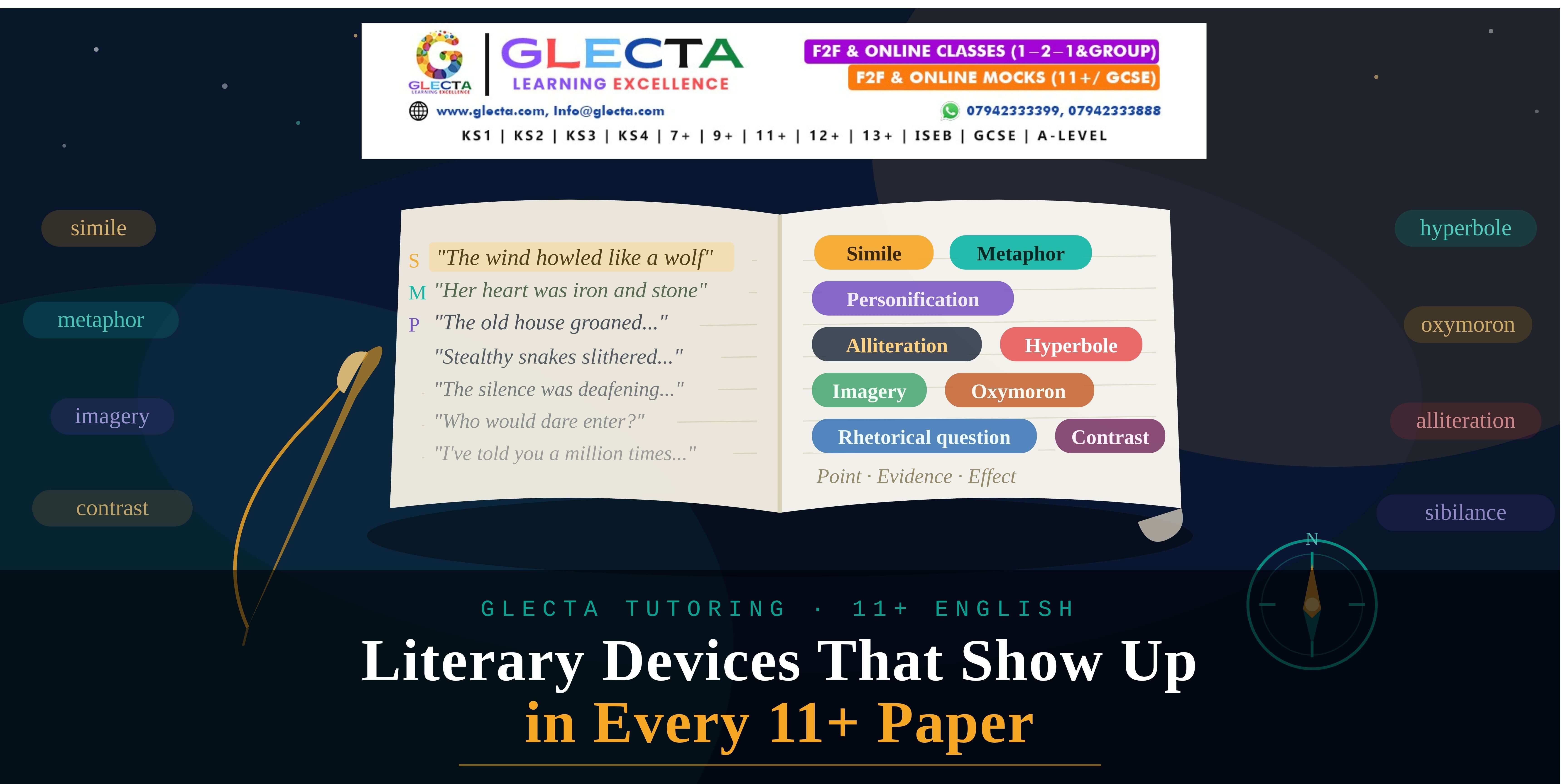

Literary Devices That Show Up in Every 11+ Paper
The 10 devices tested across GL, CEM, CSSE and independent schools — with model answers, exam strategy, and a free timed practice test.
Literary Devices — Complete 11+ English Guide
Why Literary Devices Matter So Much
The 11+ English paper will almost certainly ask about “the writer’s use of language” or “how does the author create this effect?” Those questions are testing literary devices — and the same ones appear in every paper.
Examiners do not just want students to spot devices. They want to see that a student understands why the writer made that choice — what feeling, image or idea it creates in the reader’s mind.
“This is a simile.”
“The simile compares the wind to a howling wolf, creating a sense of danger and making the setting feel threatening.”
That distinction — between naming and explaining — is the difference between average and top-mark answers. This guide closes that gap.
The 10 Devices Tested in Every Paper
These appear across GL, CEM, CSSE and independent school papers. The first five are the most frequently tested — learn them in this order.
Spot it: look for like or as. Then ask: what two things are compared, and what quality is shared?
Spot it: verbs/adjectives normally used for people — whispered, smiled, danced, groaned, screamed. Always link the human quality to the mood it creates.
“Dark, dangerous dungeon.” (hard ‘d’ sounds)
The Formula That Earns Full Marks Every Time
Use it in every comprehension answer about language. Two to three focused sentences. One device, one quote, one clearly stated effect.
Examiners reward precision over length. A sharp two-sentence answer beats a rambling paragraph every time.
Exam Strategy — Comprehension
Using Devices in Your Own Writing
Devices should enhance your writing, not clutter it. A reader should feel the effect before they notice the technique.
6 Mistakes to Stop Making Immediately
10-Minute Practice Test
Part A: open comprehension passage • Part B: 10 multiple-choice questions. Set a timer and work through both.
The Parent Playbook
Six minutes a day beats sixty minutes once a week. Here is what actually makes the difference.
- 1Keep it tiny and daily. Consistency builds pattern recognition faster than any single long session.
- 2Stop “kind of” answers. Push back: “alive how? What feeling does that create?” Precision is exactly what examiners reward.
- 3Always ask “why.” After every answer: “Why did the writer choose that device here?” This trains exam-style explanation.
- 4Rotate contexts. One day spot devices in their reading book. Another day use one deliberately in a creative writing sentence. Variety embeds understanding.
- 5Mini-tests every week. A 5-question Sunday recap — verbal, not written — keeps retention strong and reveals gaps before exam day.
The Glecta Advantage
At Glecta, we build English language skills into the full 11+ journey: the learning plan, the timed technique, the mock feedback, and the parent support that keeps the whole machine moving.
Our tutors teach students not just to name devices but to deploy the PEE method fluently under exam pressure. We support families through Year 3 foundation, Year 4 core, Year 5 advanced, intensive and half-term courses, and right through to National Offer Day. We also run free webinars for parents on exam boards, mock interpretation, and confidence-building.
Related guides
Frequently Asked Questions
Quick links
Ready to Give Your Child the Best Chance?
Join thousands of families who trust Glecta for structured 11+ preparation, expert mocks, and personalised feedback.